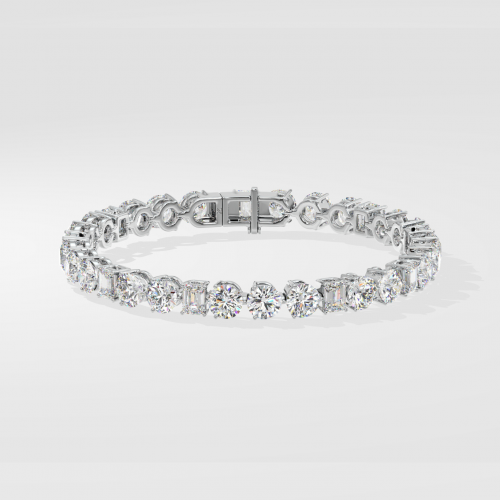
“Blended Solitaire Tennis Bracelet” has been added to your cart. View cart
Certification
What is Diamond Certification?
A diamond certification, more commonly referred to as a diamond grading report or quality document, is an in-depth assessment of a diamond’s many aspects. It consists of its size, clarity, hue, polish, symmetry and other factors that affect its value. The process involves an expert gemologist analysing it through close inspection with the use of a jeweller’s loupe, microscope and likewise tools. A comprehensive certificate is then prepared by these qualified professionals who provide a precise and impartial judgement of the stone.
Why is certification important?
An independent and reputable certification laboratory is essential if you want an unbiased assessment of a diamond’s quality. By doing so, consumers can easily compare lab-grown diamonds on their specific parameters to know they’re getting what they’re paying for. The diamond industry widely accepts IGI’s diamond grading reports for their accuracy, reliability, and impartiality.
More about IGI
IGI (International Gemological Institute) is the leading grading body in the diamond industry that provides specific gradings for the four Cs in lab-created diamonds. As the most popular lab-created diamond certifier, IGI is used by the majority of the lab market, ensuring consistency in grading.
Certification Information
Diamond certification reports usually include the following information: Carat weight Cut grade (for round diamonds) Colour grade Clarity grade Polish grade Symmetry grade Measurements (diameter, depth, table, etc.) Proportions (crown height, pavilion depth, etc.) Fluorescence Comments or remarks
Our Full Collection
Discover iconic designs by our in-house team of master jewellers.
Clarity reflects the purity of a diamond or the inclusions and blemishes in a diamond. The inclusions and blemishes impact a diamond’s ability to let in light and reflect its brilliance. Inclusions are interior irregularities and blemishes are exterior irregularities. These imperfections are not flaws, but rather the natural fingerprint of every diamond. Often, we can see these only under a powerful microscope or jeweler’s loupe, and they do not visibly affect the appearance or beauty of a diamond. Large inclusions can affect the scintillation of a diamond considerably be absorbing the light passing through. Some inclusions are coloured too, the most common one being “Nats”- a black inclusion, which is considerably big, and can be easily spotted by the naked eye. The larger or more numerous the inclusions the less valuable the diamond.
Internationally, diamonds are graded by labs according to the following grades:
FL Flawless: These diamonds are completely clean and have no inclusions or blemishes detectable under 10x magnification. They are extremely rare and expensive.
IF Internally Flawless: These diamonds have no detectable inclusions but may have some surface blemishes under 10x magnification. They are very rare and very valuable.
VVS1/VVS2 Very Very Slightly Included: Inclusions and blemishes are extremely difficult for even a skilled gemologist to detect under 10x magnification, usually visible only under a powerful microscope.
VS1/VS2 Very Slightly Included: Inclusions and blemishes are detectable under 10x magnification, but are minor flaws that do not impact the diamond’s beauty and are totally invisible to the naked eye.
SI1/SI2 Slightly Included: Inclusions and blemishes are easily noticeable under 10x magnification and may also be visible to the naked eye.
I1, I2, I3 Included: Inclusions and blemishes are obvious under 10x magnification and typically visible to the naked eye. These flaws may negatively impact the transparency and or brilliance of the diamond.